Our Projects
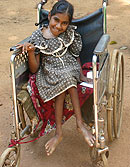
1. Sponsor a Handicapped Child
Objective: Identify needy families of handicapped children living in remote areas of the hill country; match them with sponsor families, societies, or individuals abroad who wish to give that child a better chance in life, design and oversee individual schemes to bring lasting change to the lives of handicapped children and their families.
Location: Haldummulla Division of Badulla District only at present
Description: Liaise between donors, needy families of the handicapped, and the Ministry of Social Services to facilitate and report on customised sponsorship schemes to improve children’s health, education and general welfare.
Donors: Suyin and Steve Karlsen of USA
Partners:
- Hill Country Disability Group
- Ministry of Social Welfare, Haldummulla Division
- National Secretariat for Persons with Disabilities
Period: Launched in January 2007, as long as sponsors are willing to sponsor the children.
Benchmarks:
January 2007: Suyin & Steve Karlsen of USA learn the plight of 11-year old Erosha Dharmapala, whose disability forced her to stop attending school two years ago, offering to pay for a qualified tutor to visit Erosha daily so she can continue her education.
February-March 2007: SLCT & Hill Country Disability Group volunteers liaise with local officials to create an official and legal arrangement whereby Ministry of Social Welfare officials and SLCT volunteers jointly set up and monitor a pilot scheme for Erosha’s education at home.
April 2007: Ms. Dilhani Wijeyatunga, an educated but unemployed young widow, scheduled to begin tutoring Erosha regularly, but after prolonged delays finds employment elsewhere.
10-11 June 2007: Purchase & presentation of art supplies and study materials to Erosha so she can commence home activities even without a tutor.
25-27 July 2007: Ms. Anna Baumann, A German woman residing in South India, stays for two days with Erosha & family to study their needs, finds that Erosha has artistic talent but also family problems that need to be addressed.
1 August 2007: Erosha's 3 hrs/day home schooling begins under Ms. Buddhika, a young mother and family friend living next door who has passed her Advanced Level examination.
4 August 2007: Erosha, along with her sister and parents and teacher Ms. Buddhika, go for a 95-km tour by car of the high hill country of Bandarawela, and visit Koslanda Nanasala with SLCT Secretary Patrick Harrigan. Erosha sees a town, Bandarawela, and the Hill Country for the first time in her life, and has an opportunity to view this web site on Koslanda Nanasala computers.
Remarks: This scheme has had to make painfully slow progress through a local bureaucracy that is unaccustomed and often resistant to innovation. Once set up and running, however, this scheme can serve as a model and precedent for other instances of sponsored children.
Visit Erosha's gallery of drawings
2. CDMA Telecom Livelihood Scheme
Objective: Empower Hill Country handicapped families by setting up a small scale self-sustaining digital voice communications network to enable group communications among the disabled and employ the handicapped as self-employed telecom entrepreneurs serving their isolated communities by providing them (or their families in cases of severe disability) with CDMA digital wireless phones.
Location: Initially in Haldummulla Division of Badulla District
Rationale: Handicapped people living in hill areas suffer two-fold deprivation: both from social-geographical isolation and from lack of livelihood opportunities. CDMA fixed wireless phones are inexpensive and work well in isolated rural communities that lack fixed line connections. Families of the handicapped, provided with subsidized Lanka Bell CDMA phones, can serve remote communities as the local telecom facility, generating a modest income meeting the cost of their own calls so they can break their isolation through a self-sustaining phone network transforming widely scattered handicapped families into a 21st Century ICT-linked and empowered self-help society.
Description: Handicapped youths can become young entrepreneurs operating a small public telecom service out of their homes using affordable CDMA phones. Family members may also be trained so responsibilities may be shared. Isolated hill communities (like tea estates) that have no fixed line phone service will have convenient telecom service at inexpensive fixed line rates. Project rapidly deploys a self sustaining phone network for the handicapped who can easily contact one another, promoting group communications among the disabled, lifting the veil of isolation to give the handicapped members broader mental horizons, and promoting a sense of full citizenship in their community and in the world. Members' social status can change overnight from being information deprived community liabilities to being self employed telecom proprietors serving isolated communities by providing affordable telecom facilities. The phones also support text messaging, conference calls, Internet access at 230 kbps, and other digital features.
Donors: To be identified. Project is available for sponsorship.
Partners:
Period: Initial pilot project to network twelve families in Badulla District in calendar year 2008
Benchmarks:
April 2006: first formulation of project concept presented to ICTA
May 2007: Director, National Secretariat for Persons with Disabilities, pledges NSPD support.
October-November 2007: Submit updated proposal to Kiwanis International, Lanka Bell Pvt. Ltd. and other potential project sponsors.
April-May 2008: Deploy first 6 phones to selected handicapped families in Badulla District; train them to use phone and keep accounts; help handicapped families to network with each other using phones for conference calls, etc.
Remarks: This project is simple, scalable, and involves only small inputs since the CDMA phones themselves are cheap. Ironically, it is also so novel and without precedent, and so small as a pilot project, that sourcing the start up funds has been problematic. At last Lanka Bell Pvt. Ltd. has agreed to supply the first six phones in April 2008.
![]()
|